The businesses Companies House cannot see.
The corner shop, the chip shop, the one-man garage, the village pub. A huge part of the economy worth buying is not a limited company — so it is not on the register everybody else searches. It is on the registers that exist because those businesses are regulated, and this searches those instead.
Regulation is the reason the data exists.
A food business must be inspected, so it is on the food hygiene register. A garage that does MOTs must be approved, so it is on the DVSA list. Carrying waste commercially needs a licence, and the licence names the holder — sole traders included, recorded as sole traders.
None of that depends on the business being a company, which is exactly why these registers reach the owners nobody else can list. It is all public information, published by the regulator. The work is finding it, joining it up, and knowing which rows are worth a letter.
Five sources. One list.
One search, every source
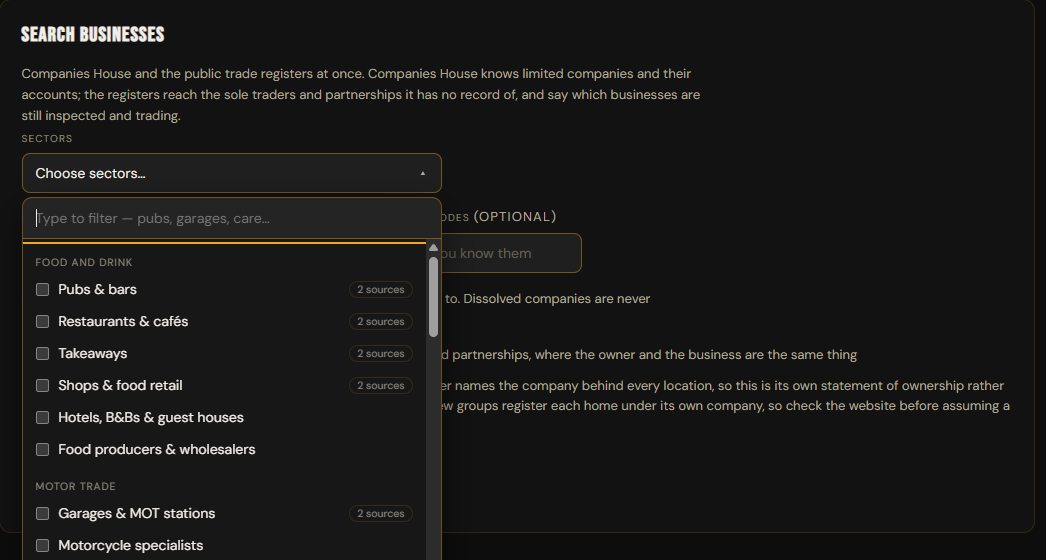
Companies House and all four registers at once, with as many sectors as you like in a single search. One merged list out, not five tabs to reconcile.
The same business, joined up
A pub on the food register and its limited company on Companies House come back as one row, with both sources shown. Corroboration from two registers is the strongest thing this screen knows about a business.
Chains flagged, not guessed at
A Greggs branch is not an acquisition target. Known brands are recognised, and a name repeated across a few local sites is marked — because a two-site operation often is the target.
Nobody written to twice
Anyone who asks not to be contacted is suppressed permanently, and a business you have written to is held back for 90 days. Enforced when the letters are built, not left to your memory.
14 sector packs across four registers.
Plus Companies House for the limited companies. Pick the sectors you buy in and search them together.
Food hygiene ratings
Food Standards AgencyEvery food business must be inspected, so every food business is on it — including the ones that are not companies.
Pubs, restaurants & takeaways
Pubs, bars, restaurants, cafés, takeaways, sandwich shops, caterers and mobile caterers — including the ones that are not limited companies.
Shops & food retail
Convenience stores, newsagents, off-licences, bakers, butchers, greengrocers, farm shops and supermarkets.
Hotels, B&Bs & guest houses
Hotels, bed and breakfasts and guest houses that serve food, which is nearly all of them.
Food producers & wholesalers
Manufacturers, packers, farmers, growers, distributors and importers of food.
Approved MOT testing stations
DVSAA garage cannot do MOTs without approval, and the approval is public.
Garages & MOT stations
Independent garages and MOT stations testing cars and light vans — the classic owner-run workshop, very often a sole trader or a partnership.
Motorcycle specialists
Stations approved for motorcycles. Small, specialist and almost never part of a group.
Commercial vehicle workshops
Stations approved for light commercial vehicles, minibuses and coaches — workshops with fleet and trade customers rather than passing retail.
Waste carriers, brokers and dealers
Environment AgencyCarrying waste commercially needs a licence, and the licence names the holder — including sole traders and partnerships, which it records as such.
Builders, landscapers & waste trades
Businesses licensed to carry waste commercially — skip hire, muck-away and scrap, but also builders, groundworkers, landscapers, tree surgeons and driveway contractors. Upper-tier registrations only, which means carrying waste is a real part of what they do rather than a plumber taking a boiler to the tip.
Sole traders & partnerships only
The same licensed trades, filtered to businesses that are NOT limited companies — sole traders and partnerships, where the owner and the business are the same thing and there are no filed accounts to read.
Registered locations
Care Quality CommissionCare is regulated per location, and the register names the provider running each one.
Care & nursing homes
Residential and nursing homes. The register names the company that runs each one and how many it runs, so a family-run single home can be told from one of a group's — which in this sector is the whole question.
Home care agencies
Agencies providing care in people's own homes. Asset-light, owner-run, and the largest single pool of independents in the register.
Dental practices
Dental practices. A classic consolidation sector, so the ownership column matters: the independents are the ones not already owned by a group.
Supported living
Supported living and supported housing services, and shared lives schemes.
Private clinics & diagnostics
Independent clinics, diagnostic and screening services, rehabilitation and long-term condition services. Mostly private-pay rather than NHS-contracted.
What a register cannot tell you.
A premises register knows a building, not a person. Most of these give you a trading name and an address and nothing else — no owner name, no company number, often no phone and almost never an email.
That is said on screen beside every search, not buried here. It matters because a letter cannot be addressed to somebody whose name nobody publishes — so it is addressed to the owner as a role, which is honest, rather than to an invented name. Where a business IS a limited company, Companies House fills in the rest.
It also means this is a tool, not a lead list. It finds businesses that match what you buy and helps you write to them properly. It does not promise that any of them want to sell, and anyone promising you that about a cold list is guessing.
A letter, not a mailshot.
Owners of the businesses worth buying are not reading cold email. A letter on a proper letterhead still gets opened.
Your letterhead, your logo
Letters go out on your own letterhead with your logo, because an approach letter is judged in the second before it is read. A letter with no letterhead is a mailshot.
Templates you can start from
Starter letters to copy and edit as your own, with merge fields for the business name, town and sector — and an honest fallback where a register gives no owner name.
See exactly what would go
Before anything is sent: how many would go, how many were held back and why, what it would cost, and three of the actual letters in full. Not a count — the letter.
Print them yourself, or have them posted
Download a PDF, one letter per page, for your own printer. Or connect your own print-and-post account and send them from here, a click at a time.
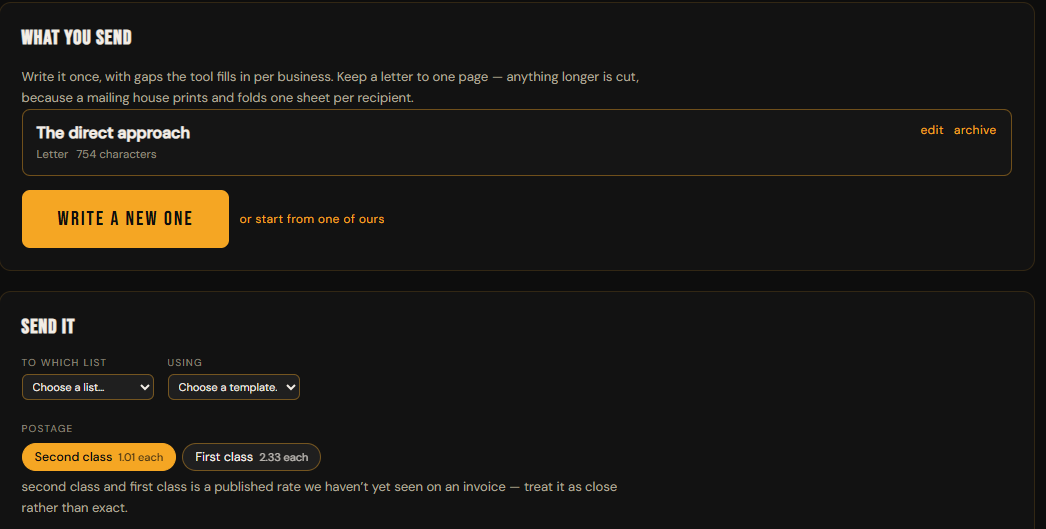
Letters are the channel built today. You connect your own print-and-post account and pay the printer directly — around a pound a letter including postage — so there is no markup from us on anything you send.
Part of Deal HQ + Sourcing
Sourcing comes with the whole of Deal HQ — the pipeline, the valuation modeller, the diligence tracker and the data room — plus the full Toolkit. Finding a business is the start; you will want somewhere to run the deal.